


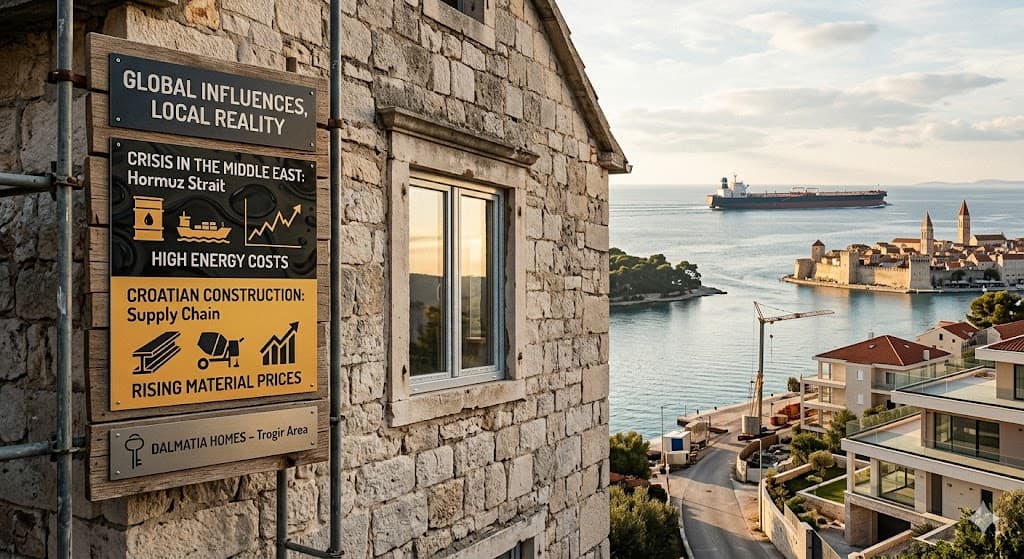
When thinking about buying an apartment in Zagreb or a stone house near Trogir, we usually look at local factors: location, proximity to the sea, domestic bank interest rates, and infrastructure projects. However, in today’s deeply interconnected world, events unfolding thousands of miles away have the power to change the rules of the domestic real estate market overnight.
War conflicts, geopolitical tensions in the Middle East (including Iran and strategic maritime routes), and fluctuations in oil prices create a “domino effect” that directly hits the Croatian construction sector and, consequently, the pockets of end buyers.
Here is how global shocks reflect on real estate in Croatia and what this means for you.
1. The Energy Crisis and the Strait of Hormuz: Why Oil Dictates the Price per Square Meter
Geopolitical tensions in the Middle East and potential blockades of the Strait of Hormuz—a sea passage through which a fifth of the world’s oil and liquefied natural gas (LNG) passes—have alarmed economists and the construction sector across Europe.
The construction industry is extremely energy-intensive. When the price of oil on world markets jumps toward or above $100 per barrel, the production costs of key materials automatically rise:
- Steel and Cement: Production of steel in electric arc furnaces and the baking of clinker for cement consume massive amounts of energy. Any spike in energy prices immediately pushes up the factory price of these materials.
- Petroleum Derivatives on Construction Sites: Materials such as asphalt and polymer waterproofing coatings directly depend on crude oil.
- Costlier Transport: Higher fuel costs mean more expensive transportation of materials from the factory to the construction site.
The Impact on Buyers: Investors building new properties are forced to calculate these increased costs into the final price per square meter. Because of this, new construction in attractive locations continues to hold high prices, despite a general cooling of the broader market.
2. Broken Supply Chains and Delivery Delays
Croatia procures most of its basic materials (like bricks and cement) from the European market. However, problems arise with specialized equipment—installations, smart systems, heat pumps, solar panels, and finishing elements imported from Asia.
Due to geopolitical risks on shipping routes, cargo ships bypass unstable areas, which extends shipping times around Africa and dramatically raises maritime insurance rates.
- Increased Uncertainty for Investors: Contractors are more hesitant to sign “fixed-price” contracts because they cannot predict what material will cost in six months.
- Delayed Completion Dates: Buyers purchasing properties in the construction phase must be prepared for more flexible moving-in deadlines.
3. Shifting Profiles of Foreign Buyers
Following its entry into the Eurozone and Schengen, Croatia became exceptionally attractive to foreign investors. However, economic slowdowns in Western Europe (such as Germany and Austria), partly caused by high energy costs and inflation, have made buyers more cautious.
- Drop in Transaction Volume: Data indicates a general decline in the number of property sales nationwide. Foreigners are no longer buying “just anything” at unrealistic prices.
- A Flight to “Safe Havens”: On the other hand, in times of global uncertainty, real estate is historically viewed as the safest refuge for preserving capital value (a safe-haven asset). Wealthier investors therefore prefer premium properties on the Adriatic coast (luxury villas, first row to the sea) over stocks or bonds.
Tips for Buyers and Sellers in Volatile Times
The Croatian real estate market is currently going through a phase of maturity and greater selectivity. Improvisation no longer cuts it.
For Buyers:
- Focus on Energy Efficiency: In an era of volatile energy prices, the difference between a property with an A energy rating and one with a D rating can mean thousands of euros in utility savings annually.
- Take Your Time to Negotiate: Since the overall number of transactions is down, buyers today have significantly more bargaining power than they did two or three years ago.
- Verify the Developer: If you are buying a new build, choose established developers who have the financial stability and material reserves to successfully complete the project despite global shocks.
For Sellers:
- Be Realistic with the Price: The days when every property sold within 24 hours at unrealistic prices are behind us. Overpricing today simply means your property will sit on listing sites for months.
- Highlight Sustainability: If your property features modern insulation, a heat pump, or solar panels, this is currently one of your strongest selling points given the global energy climate.
Conclusion
Global geopolitics is no longer a topic reserved only for macroeconomists. Every conflict in the Middle East or spike in oil prices directly impacts how much a bag of cement costs, and consequently, the price of an apartment in Croatia.
Nevertheless, the Croatian market—especially the coast and the Makarska and Trogir rivieras—shows exceptional long-term resilience. The key to success in these challenging times lies in staying informed, exercising patience, and making realistic property valuations.


Join The Discussion